
Part 2 1870 – 1890
Henry Thompson was an immigrant and a veteran of the American Civil War. He was also a favorite uncle of my husband’s grandmother who remembered him fondly. Called “Harry” by the family, he reportedly had a twinkle in his eye and an easy going personality. Family lore told of a bachelor uncle who traveled a lot and reportedly there was some mystery about his whereabouts for a period of his life as far as the rest of the family was concerned. In hearing grandma talk about him, I had the impression that he went missing during his service in the military, but the more I learn about Henry, the more I think that she was referring to the years after the war. I found some records tracing Henry’s life, from his christening in Liverpool to his home in Milwaukee in 1850, but there were long periods of gaps in the records in his later life that I wanted to fill in. I knew about his military service, so I looked for him there first.
I ordered Henry’s pension file through Gopher Records and the documents and testimony included in the file went a long way toward filling in the gap years. In part 1 of Henry’s story, I outline the early years of Henry’s life through his time in the war and up to about 1870 when he moved to Chicago. The new information revealed in the pension documents for that period of Henry’s life included a younger brother that was unknown to me, and the death years and locations of Henry’s parents. It also included some hints on Henry’s brother John’s life after he set out on his own.
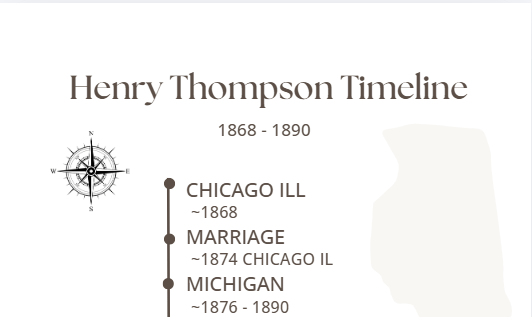
The timeline left off as Henry moved to Chicago after living in Buffalo, New York for several years before and after the war. Henry never gave reasons for any of his moves in his interviews. I know that Henry’s sister, Eliza Jane, married in 1870 and that she and her new husband, William R. Smith, moved to Chicago for a few years right after the marriage. Perhaps Henry moved closer to home to be near family, or perhaps his sister moved to be near him. Perhaps it is simple coincidence. In any case, Henry also revealed in his pension papers that while he was in Chicago he found a wife.
The Wife
Henry’s first paperwork for his pension in 1905 reported no wife and no children upon his admission into the Veteran’s Hospital in Sawtelle, California. In later documents, Henry would report that he had misunderstood the question at that time and reported in 1915 and in 1925 that he was married in Chicago in 1874 to Mahala Brinkman. In 1915 he names E.F. Barton of the Christian Church as the person who performed the marriage. When asked if there is any official record of the marriage, Henry replies that he “does not know, thinks not”. In 1925, Henry reported that he was married only once to Mahala Brinkman in Chicago in 1874 by “Rev. Barton minister of the Christian Church” and that there should be a record of the marriage in Chicago. I have searched for a marriage record for Henry and Mahala in and around Chicago and am unable to find one.
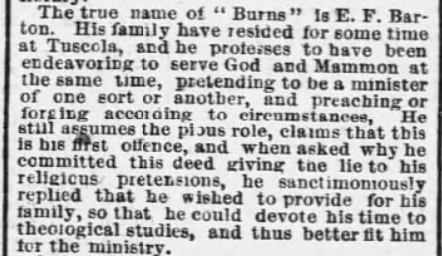
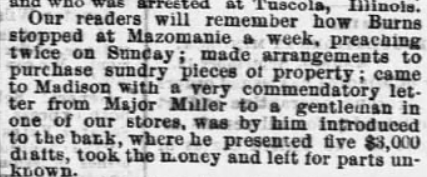
I thought that I might try to locate the clergyman and see if I could determine which church he served, but the only E. F. Barton I could find was a man who was traveling around Illinois and southern Wisconsin going by the name A. Burns who would preach on a circuit of sorts and was involved in a forgery scheme stealing $7000 from a Wisconsin bank to buy land in Illinois. He was arrested in 1867 and was released from prison in 1871. It was mentioned in the newspapers that Burns thought of himself as a theology student and that he reportedly said that he was stealing so that he could support his family so that he could spend more time on his religious studies. Could this be the man who performed Henry’s marriage? I can find no E F Barton in the Chicago City Directory for 1874 or 1875.
Henry’s summation of his marriage was limited to just a few phrases and vague statements. In 1915, Henry reported that he was married “but the one time” and that Mahala was also married “but the one time.” He stated that he “had not heard from [her] since 1875 or 1876” when asked “are you now living with your wife, or has there been a separation?” When asked to state the names and dates of birth of all his children, living or dead, Henry answered “one female child, died in infancy.” This was the first mention of Henry having a child.
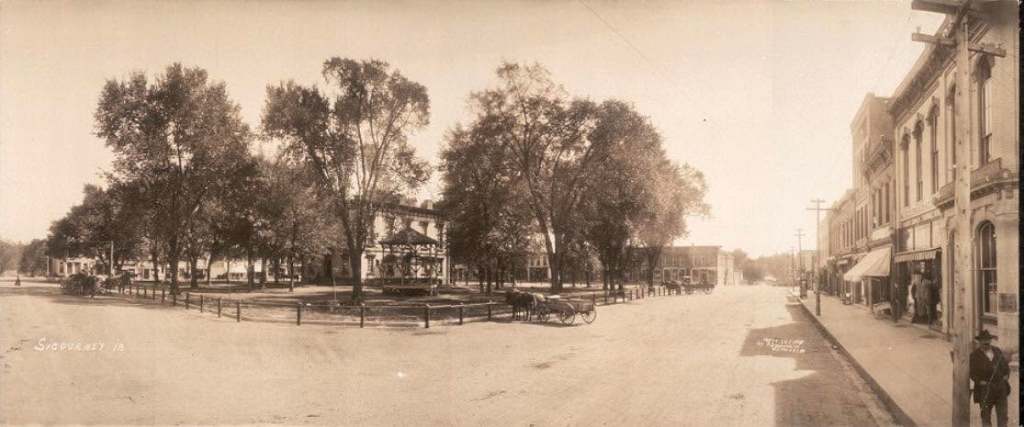
In his deposition in 1925, Henry stated that the marriage occurred “I think in 1874”. Henry reported that Mahala died “about 1888 or 1889, somewhere in Iowa, on a farm.” He said he recalled that the post office address was Sigourney, Iowa. Henry had been “…gone some months, and was not with her when she died. I did not see her after about 1878. I heard of her death.” Henry also reported that he never “saw or met any of Mahala’s people. I do not know the first name of her father, or the names of any of her relatives.” Even more stunning to me was Henry’s memory that “There is something in my head about a baby — I remember now she went home to have a baby, and I never saw her afterward.”
I should note also that the majority of the paperwork in the pension files is not filled out directly by Henry. There are typed transcripts of his interviews and some that were handwritten by clerks as Henry was dictating. Henry was disabled by a variety of injuries and ailments over the years and was not able to use his arms or hands very well. The importance of that disability combined with the interpretive spelling of some of the names and places in these files must be considered when searching for records for the people and places mentioned. Henry’s reported wife is one example.
Henry did not give many clues as to Mahala’s identity prior to their marriage, and since I could not find a marriage record in Illinois, Iowa, Wisconsin, or Indiana, I had no way of knowing the names of Mahala’s parents. I searched for Mahala Thompson’s death in Iowa and Illinois from 1875 to 1888 with no success. I did have the specific location of Sigourney, Iowa as her home though so I looked for Brinkman’s there. There was one Mahala that kept coming up in Keokuk county, Iowa (Sigourney is the county seat of Keokuk) but she was born in about 1822. That would make her the same age as Henry’s parents, so that did not seem a likely fit even though she died in 1888. After looking into her family, I learned that she had a daughter, also called Mahala, born in 1855.
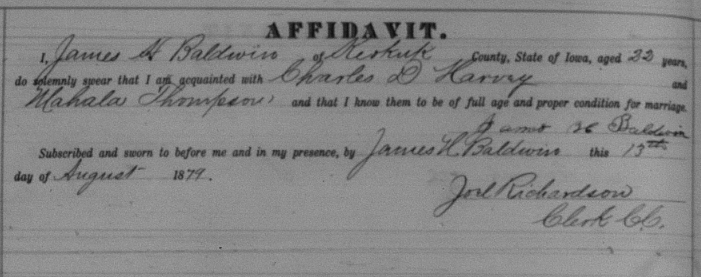
Mahala Brinkman, as she was recorded in Henry’s depositions in 1915 and 1925, was perhaps Mahala Bringman. This Mahala was the daughter of Joshua Bringman and Mahala York Bringman. She was born in Iowa or Indiana in 1855, but she did not die until 1923. She married Charles D Harvey in Keokuk county in 1879. When she married, her name was recorded as Mahala Thompson. There was no question regarding previous marriages on the marriage certificate (I ordered it from the State Historical Society of Iowa) but this Mahala is definitely the same Mahala who was the daughter of Joshua Bringman based on other records for this family. Although I find Mahala listed in several Bringman/Harvey trees, none make note that her name was not Bringman on her marriage certificate. There is no explanation that I can find for this discrepancy in the record.
I did my best to follow Mahala’s life and try to see where it may have intersected with Henry’s life but she also has missing years. She is at home with her parents in 1860 and 1870 in Keokuk county. By 1880, she is married to Charles and living in Marion, Iowa. Iowa does have a state census, but it jumps from 1870 to 1881. On the 1900 US Federal Census, she indicates that she has had 2 children, both living – this corresponds to her children with Charles, but would not include a deceased child with Henry. In 1910, she indicated 1 marriage and 2 living children. Mahala was a widow living alone by 1920. Charles was also an American Civil War veteran and Mahala did file for a widow’s pension in 1911, so it is possible that answers may lie in yet another pension file.
I found Henry’s lack of recall about what most people would remember as significant events in a life to be odd. It sounded as though the marriage was not a happy one and that it did not last very long – if it ever legally took place at all. Henry did not even give the name of his child when asked. He did not know when Mahala died to any certain degree – and in 1915, he does not say that she is dead, just that he had not heard from her since about 1875/1876. Henry said he had heard of her death in about 1888/1889 in his deposition in 1925. Was he confusing her death with that of her mother? Who did he hear about it from? He stated that he did not know any of her family or even her father’s name, so who would have told him? By 1888 he had not heard from her for 10 years according to his own testimony. This is a puzzle that is going to take time to put together.
Henry notes in his deposition that he was in Michigan from about 1878 to about 1890, though he does not say where or what he was doing there. I am unable to locate Henry on the 1880 US Federal Census in Michigan, but he does appear in Marquette on the 1890 Veteran’s census. Unfortunately, the veteran’s census only gives information about the men’s military service and their health issues – nothing about occupations or other family members at all. After his time in Michigan, Henry said he moved on again to California in 1890, but there is also mention of Colorado and “Old Mexico” in his pension files and Alaska is mentioned in his obituary. Henry described his occupations over time as a hack driver, a prospector, and a gardener. In the next chapter of Henry’s life, I will see what I can find in the historical record to track his movements through the western part of the US.