
Maggie Hudson
I recently joined a writing challenge called #ReclaimJane. The idea was that we all have a “Jane” in our tree – a person who was lost to history with very little evidence that they existed at all. Sometimes they were an entry on a census record, a headstone in a family plot, or a name on a marriage certificate, and then they vanish from the pages of history. Sometimes they were a person who was a parent, spouse, or sibling who have a mention peripherally in someone else’s story but seem to have no story of their own. The idea was to find our “Janes” and choose one to further investigate and write a narrative to bring them back into the light and give them their own story in our family.
I have written about a couple “Janes” in the past. Anna Ertl Bohman could have easily been a “Jane” if not for her resolve and her second marriage to Nicholas Hamus. Margaret Mahoney Aschebrock was a “Jane” who fell between census years and died tragically young. Susan Gordon Sharp was definitely a “Jane” who was lost to history and family. My “Jane” for this project is a woman called Maggie Hudson who lived in Deadwood, South Dakota in 1897 and then disappeared.
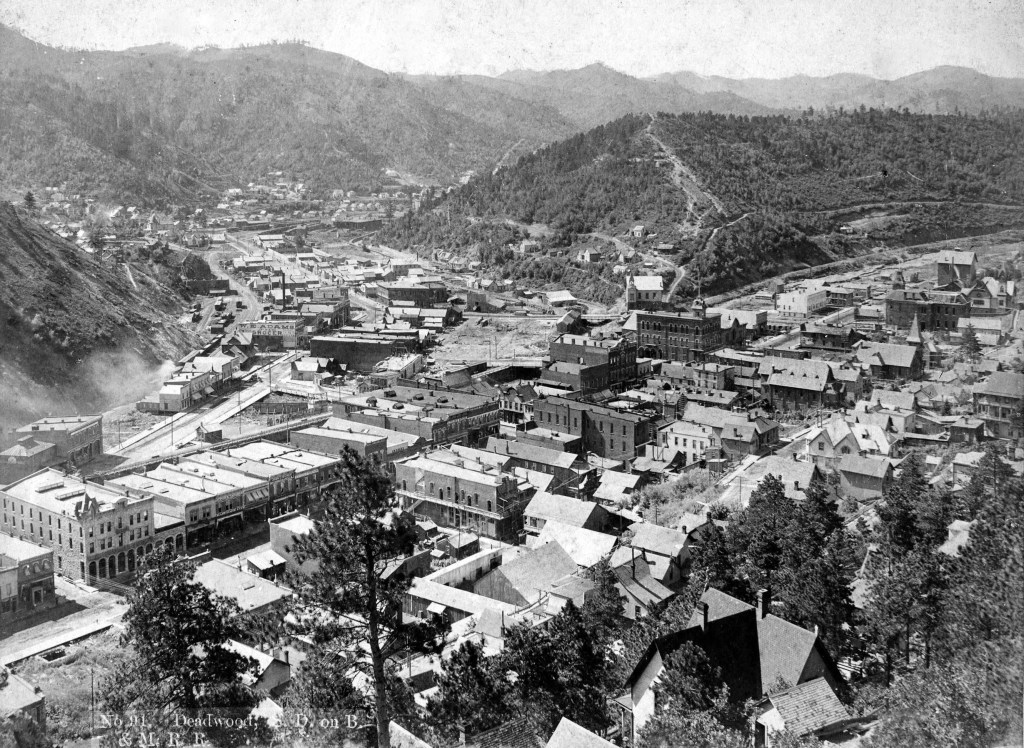
Deadwood, South Dakota in the 1890s was just coming down from the Wild West days of Wild Bill and Calamity Jane. The town was not booming quite as much as the decade before, but wasn’t faded out quite yet. Deadwood was on the railroad that connected the Midwest and the western states and was a destination in itself and a way point for those traveling to other places. About 3000 people were permanent residents in 1897, but the population was usually larger due to miners, travelers, and migrant workers.
Deadwood was home to several hotels, restaurants, saloons, and entertainment halls to cater to the ever changing populace. These establishments were always looking for employees and the newspapers of the day are full of “Help Wanted” advertisements. It was, perhaps, the ad placed by Bessie Stone proprietress of the Syndicate Restaurant asking for a” first-class girl waiter” that caught the eye of young Maggie Hudson.

Maggie appears on the unclaimed letters list in the Deadwood newspaper at the end of September in 1896. How she arrived in Deadwood is a mystery. There are a few Hudson families in the area at that time, but none with a Maggie or Margaret in them. Perhaps she was visiting extended family, or perhaps she was an immigrant new to America and looking for work. In any case, Maggie next appears as a witness in a murder case in May 1897.
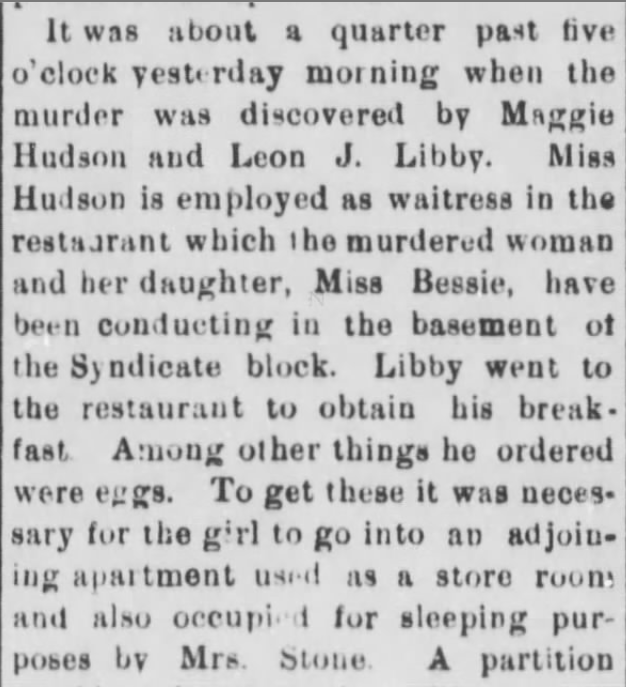
Maggie was working as a waitress in the Syndicate Restaurant and living in a room upstairs. She woke early one morning to discover that the wife of the restaurant owner had been murdered during the night. Maggie was only described as “Miss” and as a “waiter” or “waiter girl”. There is no mention of her as being from a local family, or of her nationality, or anything to describe her written in the newspapers.
Maggie testified at the trial of the accused murderer in June 1897 and is mentioned again as a witness in an article written about the execution of the accused in July 1897. There is no mention of her again in the newspapers until she appears in the unclaimed letters column in January 1898. Maggie is not mentioned in any other local papers in any other context. She appears and then disappears all in just over a 1 year period. Maggie accomplished just one other thing during her brief stay in Deadwood – she gave birth to a child.
Maggie delivered a son she named Charles Wentworth Hudson on 3 October 1897 in Deadwood. She gave him up to the Children’s Home Society on 7 October 1897. She filled out her son’s name on the intake form and listed herself as 20 years old. No father was named on the paperwork. Little Charles is listed in the newspaper as “a very young baby” who was temporarily staying with the local constable and his wife while the Children’s Home employee was further west on her rounds. Representatives from the Home traveled regularly around the South Dakota gathering orphans, abused, and abandoned children who were taken back to Sioux Falls to be placed with new families. The newspaper made sure to note that more children were taken up from Deadwood than from any other town in South Dakota.
Charles didn’t have to wait long to be placed in a home. His adoptive parents baptized him in February 1898 at their church in Flandreau, South Dakota. He was baptized with the name Roland Eugene Simons and it was noted in the church record that he was the adopted son of John Drengman Simons and his wife Pauline. Roland lived with his adoptive family until the age of 17.
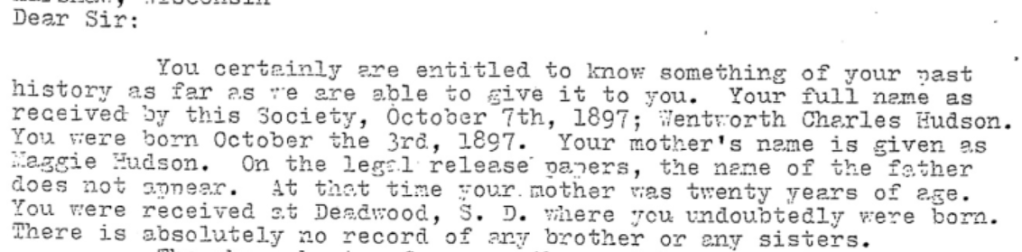
The Simons’ wrote to the Children’s Home a few times to ask for guidance regarding behavioral issues with Roland, and later to inform the Home that he was moving to Wisconsin. Roland wrote to the Children’s Home inquiring about his own history when he was 20 years old, a few months before his marriage. The Home’s reply was a list of the facts surrounding his birth and a paragraph about how he would likely never find his mother and that Roland should move on.
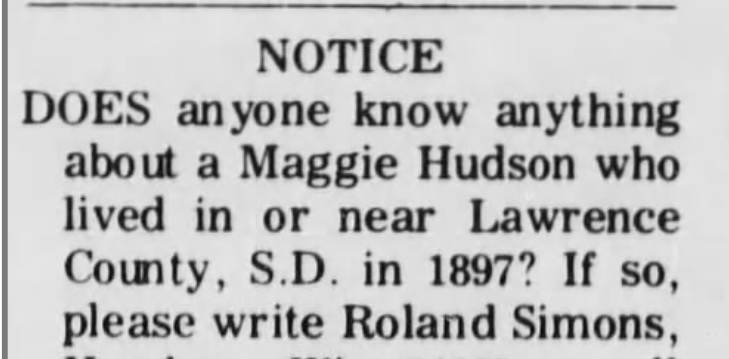
Roland never moved on. Ten years before his death at age 83, Roland wrote an ad to be run in the same newspaper that reported his mother as a witness to a murder in 1897. The ad ran for a month in 1973. He wrote “Does anyone know anything about a Maggie Hudson who lived in or around Lawrence County SD in 1897? If so, please write to Roland Simons.”
Maggie Hudson leaves more questions than answers even so many years later. Where did she come from and what brought her to Deadwood? Was she accompanied by anyone? Who was the father of her son? Was he aware of Maggie’s pregnancy? Did he know she gave birth? Where did she go after she left Deadwood?
There is no mention in the newspaper articles of the time about Maggie being pregnant, but she certainly was -both at the time of the murder and at the trial following. She was referred to as “Miss” and she was sharing a room with the daughter of the restaurant owner so it seems safe to assume that she was not married. It seems unlikely that Maggie was a prostitute considering her job at the restaurant and her living situation. Maggie gave birth and kept her son for 4 days before surrendering him to the Children’s Home Society. Did she have help with the birth, or was she alone and in hiding for those 4 days?
Maggie gave her son a name. She could have left him unnamed since she knew he was to be adopted by another family after she relinquished him. She could have kept the name she gave him secret. Maggie gave her son a name and she wrote it down so that it would be part of his permanent record and that maybe, someday, he would know what it was. “Charles Wentworth Hudson” is a strong name, a name with character, and a name that is a bit unusual.
There is a city called Wentworth in South Dakota far to the east side of the state from Deadwood. Was Maggie from that area? There was also a Wentworth Hotel in Deadwood. Did Maggie stay there during her time in Deadwood? Is that where she became pregnant? Did Maggie simply like the name Wentworth or was she leaving a message for her son?
As it happens, there was a man of Maggie’s age in Deadwood called Wentworth who arrived from Iowa in 1895. He started as a stenographer for a train depot and shortly after moved to a position at a Deadwood bank. This particular bank was located in the building above the Syndicate Restaurant where Maggie worked and lived. This young man married into a wealthy family from Deadwood in January of 1898. Wentworth was described as “honorable, influential, and highly respected.” The wedding was “a social event of no small importance” and “one of the most beautiful ever occurring in Deadwood.” He and his wife moved to California and he died there in 1916.
Although we will probably never know the circumstance of Maggie’s pregnancy, it is not a far reach to think that an accidental pregnancy by a woman of lower social class would have derailed a man’s reputation and social standing. Maggie would have had to bear her child alone. I would imagine after giving up her child, she probably picked herself up and rode a train out of town to start a new life where no one would know of her past.
The identity of the father of Maggie’s son will, for now, remain a mystery. Perhaps in time DNA will shine light and answer some of our questions. Every year, more people take these tests and hopefully a descendant of Maggie’s son will find a match to a previously unknown family. Maggie may have had more children. Finding a genetic link can hopefully answer some of the questions of her early life and about what happened to her after she left Deadwood.
 WitzEnd Family History
You’re a great storyteller. Well done.
LikeLike