
A Historical Perspective from the 1918 Influenza Epidemic
The Wisconsin Historical Society is asking for people to join their Covid-19 Journal Project. The purpose of the project is to record the perspectives of Wisconsin citizens as they experience this pandemic. The Wisconsin Historical Society has a collection of Civil War journals that have been preserved and offer a personal perspective on the daily lives of individual soldiers. These journals record not only the large events of the times, but the emotions and thoughts of the people living through them as events unfolded.
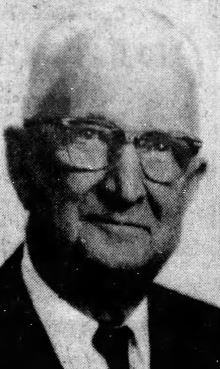
You may think that your journal could not be as interesting or as useful to future generations as the journals of soldiers during a major war, but it is hard to know what information will be valuable in time. A 1918 journal written by Adolph O. Erickson in Winnebago County during the influenza epidemic was used in a paper published by the National Institutes of Health in 2009. The diary was one source for a study of in which influenza survivors were interviewed, and various historical medical treatments for the flu were documented to give a perspective on how the rural Midwest responded to the epidemic.
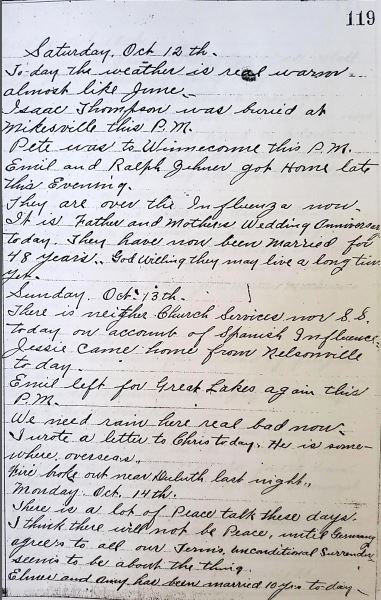
Adolph O. Erickson was my great great grandmother’s brother. I have copies of some of the pages of his journal in which he mentions his sister Mattie and her family. Adolph records mundane everyday things like the price of bread and eggs, and he also mentions the happenings of family and friends. In his journal, he mentions what the NIH paper says is the “earliest personal record pertaining to influenza cases in Winnebago County”. Adolph wrote on 27 September 1918 that “Nels Thorsen is not feeling well”. Nels Thorson was the father-in-law of Adolph’s sister, Mattie Erickson Thorson, and was my 3rd great grandfather who had survived the horrible conditions of a confederate prison camp during the Civil War. By 29 September 1918, Nels Thorson had died.
Adolph and his family attended the large funeral of Nels Thorson on 1 October 1918. In his diary, Adolph records that “The pall bearers were [Nels] five sons, Tobias, Gilbert, Alvin, Julius, Charlie, and his nephew Theo. Larson.” I had known the date of Nels’ death previously, but it never occurred to me that he was a victim of influenza. Luckily it seems as though none of the family caught the flu at the funeral.
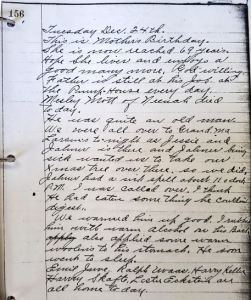
Adolph also recorded the effects of influenza on other members of the community and in his own home. The Erickson home was hit with influenza in December 1918 and thankfully all Adolph’s family survived. Adolph’s penmanship is markedly different after his illness.
The NIH paper concluded: “Our study of the 1918 and 1920 influenza epidemic in one county in Wisconsin reveals a portrait of people doing their best to respond to the most widespread public health crisis ever experienced in the United States. We found that public officials and medical professionals coped well, using the knowledge and medicines available to them at the time. For the most part, the people of Winnebago County cooperated with the quarantine and helped their neighbors, while suffering losses of family members and friends. The vivid memories of older people late in the 20th century, when they reflected back on this pandemic in the early years of the century, testified to the impact it had on the community.”
Adolph’s simple dairy of his everyday life provided personal perspective of living through the 1918 Influenza epidemic as it passed through his community. His record of happenings is unique and invaluable to me as a descendant. It astonished me that Adolph’s observations would be of value to the medical research community nearly 100 years after he recorded them.
I would encourage everyone to think seriously about preserving your thoughts, fears, frustrations, etc. about this time for future generations. Your grandchildren will be interested in your memories and who knows – you may even end up being posthumously quoted for a medical research paper!
 WitzEnd Family History
Do you know if his journal is published anywhere? I find these types of things fascinating!
LikeLike
I’m not sure if it is published. The historical society in Oshkosh has it in their collection. I had a cousin who went there some years ago and made copies of the pages where my direct ancestors were mentioned for me. That alone is a pretty fat binder!
LikeLike
That is really neat! I love reading those first hand accounts.
LikeLike