
A Timeline of an Extinct Village
Weigelsdorf was a small village that had it’s beginnings with the settlement of land north and east of Marshfield, Wisconsin by Paul and Joseph Weigel and a few other German immigrant families. The little community was along the county line between Marathon and Wood counties in Wisconsin. The area today is along McMillan street from about Galvin Avenue to about Staadt Road and many of the original farms are still there.

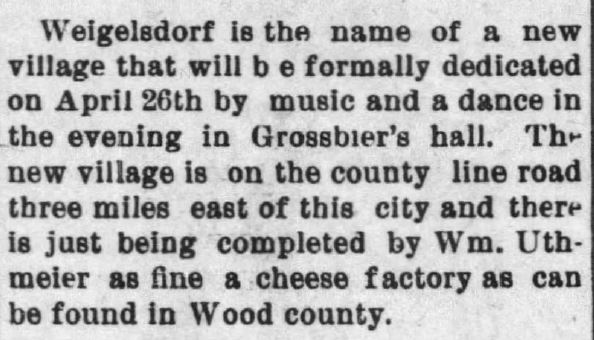
Weigelsdorf became an official village on 26 April 1908 and was dedicated in a small ceremony by the founder, Louis Bauman. He gave a short speech followed by breaking a bottle of champagne on “the forward deck of a McCormik reaper”. The community held a dance in celebration of the event. At that time, there was a dance hall owned by Joe Grosbier, and a cheese factory built by William Uthmeier on or near the corner of Staadt Road and McMillan Street.
Grosbier Hall hosted dances almost every Sunday (and sometimes twice!). The hall tried to attract the best musicians for entertainment. Acts like Gasper’s Orchestra and Marx Orchestra drew in crowds. Many of the local young people met their future spouse at these dances. The halls were used for public meetings and wedding dances as well.
The cheese factory had run fairly smoothly under the operation of BG Doell as cheese maker until about September 1911. There was some sort of legal dispute between the owner, William Uthmeier, and Mr. Doell resulting in the removal of Mr. Doell and the closure of the factory until November of that year. The factory reopened on November 1, 1911 with (my great grandfather) Henry Weigel as head cheese maker.
In March of 1912, Joe Grosbier sold his hall to Nick Zingsheim and Philip Weigel was the cheese maker at the Weigelsdorf factory.
New construction projects were mentioned frequently during the summer months in the papers. The Schlagenhaft brothers were the area masons and helped build foundations for new barns. There was always mention of farm work, livestock, and crops. Winter months brought mentions of logging to clear more crop land. The dances and visits with family and friends were year-round activities for the community.
June of 1913 brought the sale of the saloon/hall to Mike Stangl. Mr. Stangl would be the saloon keeper there for 24 years. Joe Jr. and Herman Weigel had silos delivered from Vesper in the summer of 1913.
Weigelsdorf had it’s own community baseball team. They played other area teams and were frequently mentioned in the summer newspapers. The St. Joseph Society had a team, as did Rozellville and Nick Nenning. Teams like the Weigelsdorf Terrors, the Sneider Alliance, the Tigers, and the Southsiders moved games around from farm to farm in the area.
On New Year’s Day 1914, the seven year old daughter of William Greenberg got up early to light the candles on the Christmas tree while her parents were out doing farm chores. She lit the bottom candles first and caught her dress on fire while reaching for the upper candles. She ran outside to extinguish the flames, but was severely burned and died a few hours later.
In December of 1915, Paul Weigel purchased an additional 120 acres of wild land that was adjoining his property for $4000. He added this to his original 200 acres to give his twin sons a good start at farming.
In 1917 John Pritzl was the owner of the Weigelsdorf cheese factory. He sold the business to John Froelich of North Dakota for $7000 and moved into Marshfield. August Weigel also sold his farm in 1917 to John Weisenbeck from Nebraska and moved to 6th street in Marshfield. The farm was 120 acres and was sold with all the personal property on the farm for $19, 450. Mr. Weisenbeck also bought the farm of Mike Ziegler which adjoined the Weigel property.
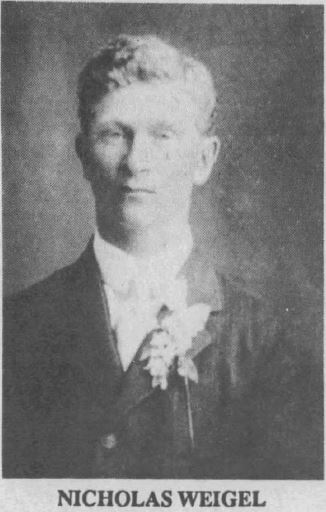
In 1918, Paul Weigel died at his home in Weigelsdorf. World War I in 1918 also brought many stories from the front from the Weigelsdorf boys who were sent to fight. First Sergent Joe P Seidl sent a letter to Mike Stangl in which he wrote about the death of his brother Louis. Joe wrote,” Louis was wounded the first day the company [A] was in line. We were charging a machine gun nest and he was hit in the left side just above the hip. I happened to be near him at that time and saw to it that he received first aid. After receiving first aid, he was sent to the rear, and on his way back was hit with a piece of schrapnel in the back which killed him instantly.” Joe wrote that he was recommended for a medal of honor after that battle. Nick Weigel, son of August Weigel was killed in the war as well.
Paul Jr and Otto Weigel installed a power plant for their farm in the fall of 1918. The power would run the milking machinery and water pumps.
On March 18, 1922 there was a fire at the Weigelsdorf cheese factory which destroyed the building. By June 15, the factory would reopen under the name of the “Farmer’s Cheese Factory” with Nick Henseler as cheese maker. The factory could process 7000 to 8000 pounds of milk daily.
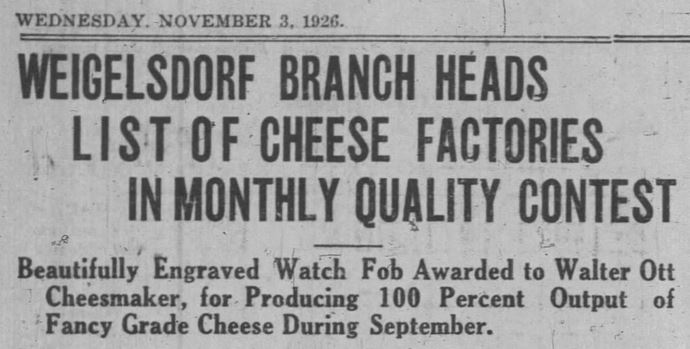
May 25, 1926 the board of the Weigelsdorf Cheese Cooperative voted to join the Wisconsin Cheese Producers Federation Warehouse with a production of 218,000 pounds. In November of 1926, Weigelsdorf cheese maker Walter Ott won the first prize for quality for his monthly score of 100.
In July 1927, Willis Hadler made the news for his arrest in Mike Stangl’s saloon at Weigelsdorf for selling stolen cars. Mr Hadler was driving a Buick sedan registered to Dominick Cinderello who was found murdered in Chicago on July 16th. Cinderello was thought to be part of the same car theft ring as Hadler.
In August of 1929, a bolt of lightning struck the barn on the Paul Weigel farm causing a fire that destroyed the barn resulting in $8000 worth of damage. Brothers Leo and Max Weigel were able to remove some equipment and drive the cattle away from the barn in time to be saved. The barn would be rebuilt by October at a cost of $3400.
The 1920s and 1930s saw the deaths of many of the pioneer settlers of the Weigelsdorf area. Some of the “old settlers” retired from farming and moved into Marshfield to enjoy their golden years. In 1935 the cheese factory closed and was put up for sale. In 1936, another severe storm damaged several buildings in the Weigelsdorf community, including ripping the roof off the Joe Weigel barn. In 1939, the Nick Grosbier family escaped a devastating fire at their home in the former Weigelsdorf cheese factory building. The family fled to the saloon which was then owned by Peter Hartl.
In 1941, the saloon/hall in Weigelsdorf was owned by Charles Schroeder and was offering fish fry and chicken fry nights along with music for entertainment. The advertisements for the hall seem to stop in early 1942. The Weigelsdorf Homemakers Club, which began in 1938, continued to meet and be active in the community though the 1940s and 1950s.
In October of 1948, Weigelsdorf pioneer Conrad Merkel celebrated his 90th birthday. He and his five brothers moved to land on the county line in 1877 and built farms. In his memories, he mentioned the arrival of the Weigel brothers in 1879. He remembered pulling stumps to clear land for St John’s Catholic Church, drying apples and baking bread in stone ovens, and the time that one of the Merkel oxen ate the bread dough that had been left out to rise by Mrs Merkel and Mrs Weigel.
The 1940s and 1950s saw more deaths of original settlers of Weigelsdorf. Mike Stangl passed away in 1953. Gust Rabe died in 1954. Mrs Paul Weigel (Anna Frenzel) died in 1957 as did John Pritzl, the one time cheese maker at the Weigelsdorf cheese factory. The Weigelsdorf Homemakers Club joined with another group to become the Mara-Wood Homemakers club in 1956.
Weigelsdorf never officially stopped being the little community on the county line, but by the 50th anniversary of it’s dedication, many if not most of it’s founders had died or moved away. The little village slowly disbanded over time. By the 1960s the village was no longer referred to in the newspapers except in obituaries and in snippets from area history. By the 1970s all the old settlers were gone. Their children and some of their grandchildren still remembered the name of the tiny village, but the village itself had been lost to history.
This post was researched following articles published in local Marshfield newspapers.
 WitzEnd Family History
2 thoughts on “Weigelsdorf”