
Nicholas Hamus
With the death of Jakob Bohman on 12 November 1892, Anna Bohman was left a 34 year old widow with 7 children ranging in age from 14 to 2 years old. She was also responsible for caring for her 70 year old mother Dorothea and the family homestead.
With no income to speak of, the Auburndale Town Board wanted to place Dorothea in a home for the aged and place Anna’s children in an orphanage. Anna had to go before the board and appealed to the men saying that as long as she had two arms and two legs, she would provide for her children and her mother. As Helen Jo Breu tells it, Anna picked up a shovel and a pick axe and went to work with the men building roads.
Anna worked and was allowed to care for her mother and children and keep her home. Anna’s oldest daughter, Anna, met a man named Peter Hamus. They married in 1894.
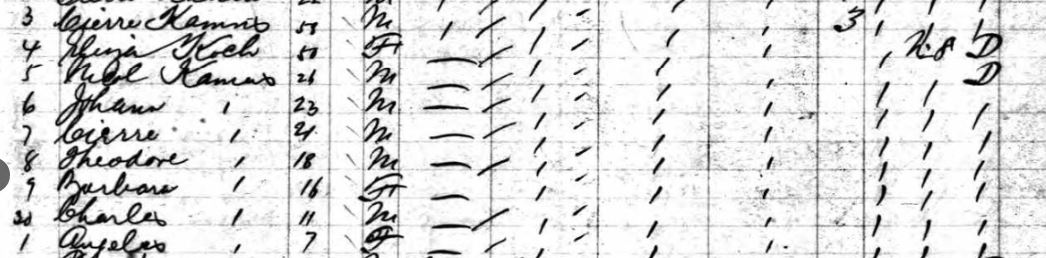
The Hamus family had immigrated from Luxembourg in 1891. The family with 7 children settled on a farm in Auburndale Township section 16.
Peter had an older brother, Nicholas, who was well known in the community. He was the owner of his own rig and made his money threshing clover seed. He was 6′ tall with black hair, brown eyes, and a handlebar moustache. He must have made a favorable impression on Anna because they married in August 1896 and their first son, Joseph Michael, was born in January of 1897.
Anna and Nicholas Hamus had four more children in the next 7 years. By all accounts, Nicholas was everything that Jakob Bohman was not. For the first time in her adult life, Anna was financially secure and in a loving relationship.
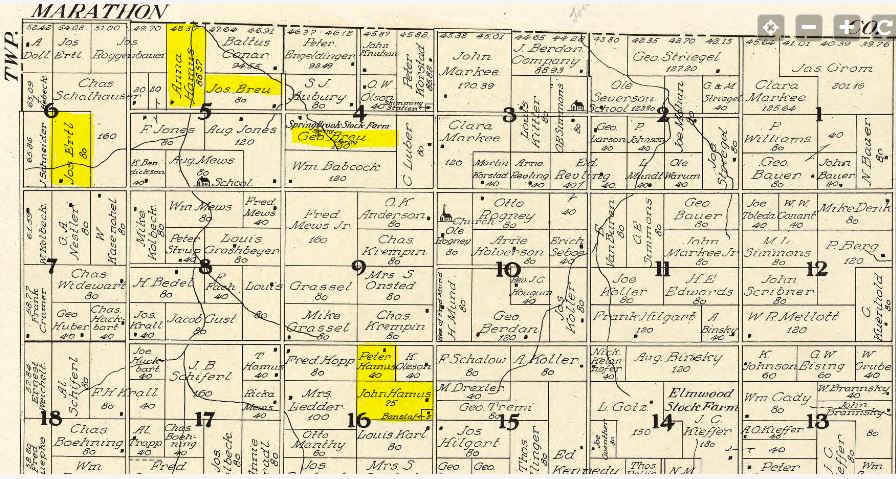
Anna and Nicholas were hard working people. Nicholas worked at his threshing business, and Anna did her part to earn money for the family too.
Helen Jo Breu remembers that Anna grew a great field of cabbages every year that she turned into sauerkraut. She sold it in wooden barrels to Nate Kohler who managed the Kohler Grocery store in Marshfield. Anna also sold her recipes for kolaches and struedel to the Vienna Bakery in Marshfield which later became Adler Bakery.
Anna and Nicholas had better relationships with the native people in the area too. Helen Jo Breu remembers Anna telling her about “Indians” coming to trade venison and maple syrup for butter and herbs. Helen said, ” When Indians came to the Breu or Hamus house they squatted upon their floor. When they ate their fill they took along their leftovers. Never did Indian waste.”
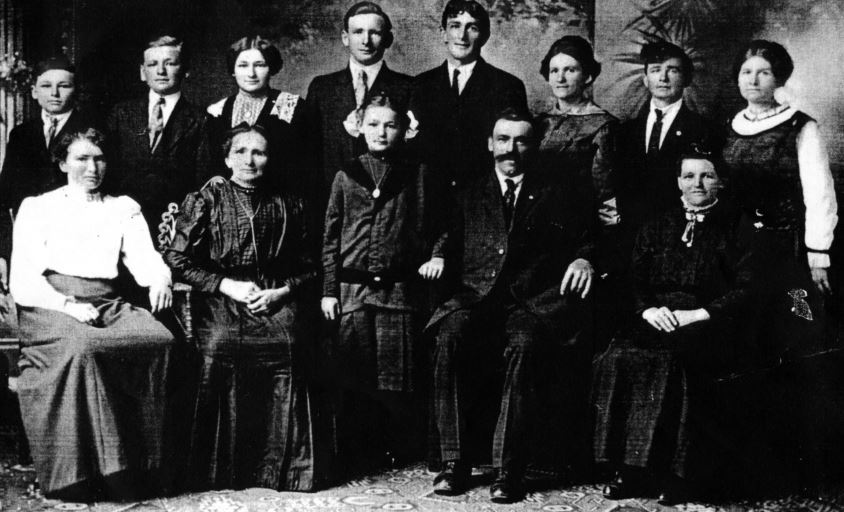
Front row Left to Right: Mary Bohman, Anna Bohman Hamus, Olive Hamus, Nicholas Hamus, Margaret Bohman
Back row Left to Right:Nicholas Hamus, Jr, John Hamus, Caroline Hamus, Joseph Hamus, George Bohman, Rose Bohman, Peter Bohman, and Theresa Bohman
You can read the previous chapters of this story here: Stories from Squaw Creek Homestead: Hyršov, Stories from Squaw Creek Homestead: The Voyage, Stories from Squaw Creek Homestead: Jakob Bohman
These memories were passed down by Helen Jo Breu in letters written to my great great grandmother, my grandmother, and to me over several years from the early 1980s to the late 1990s.
 WitzEnd Family History
3 thoughts on “Stories from Squaw Creek Homestead”